
Know your risk
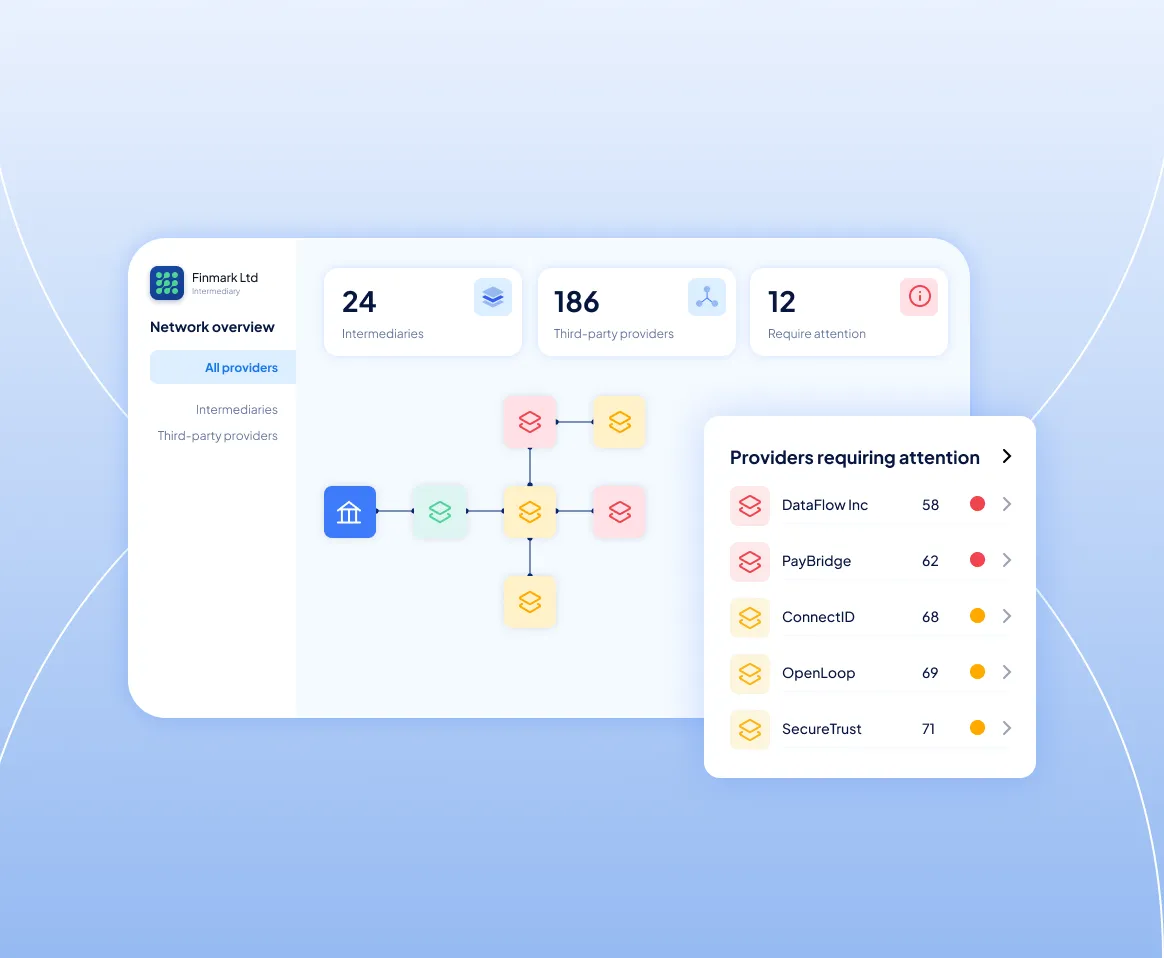
Risk Indicator gives financial institutions continuous, real time visibility into every intermediary and third-party provider's risk. And it gives intermediaries and third-party providers a live, actionable score of their own standing - with clear information on how to strengthen it.
Risk scores update continuously, not annually.

Risk doesn't wait for the next review
Accreditation confirms who's fit to connect on day one. But risk profiles can shift the day after - which means most companies have no visibility of the risk they carry.
A point-in-time check can't catch what happens in between
Once a third-party provider is connected, financial institutions are blind to how its risk profile changes.
No visibility into your own risk, or your downstream risk
Intermediaries and third-party providers rarely know where they stand until risk becomes an incident - because much of that risk isn't visible: a downstream connection's exposure can affect their own standing long before it shows up as a problem.
Invela Risk Indicator: continuous scoring,
informed action
Invela Risk Indicator replaces the once-a-year check-in with a score that moves as risk moves.
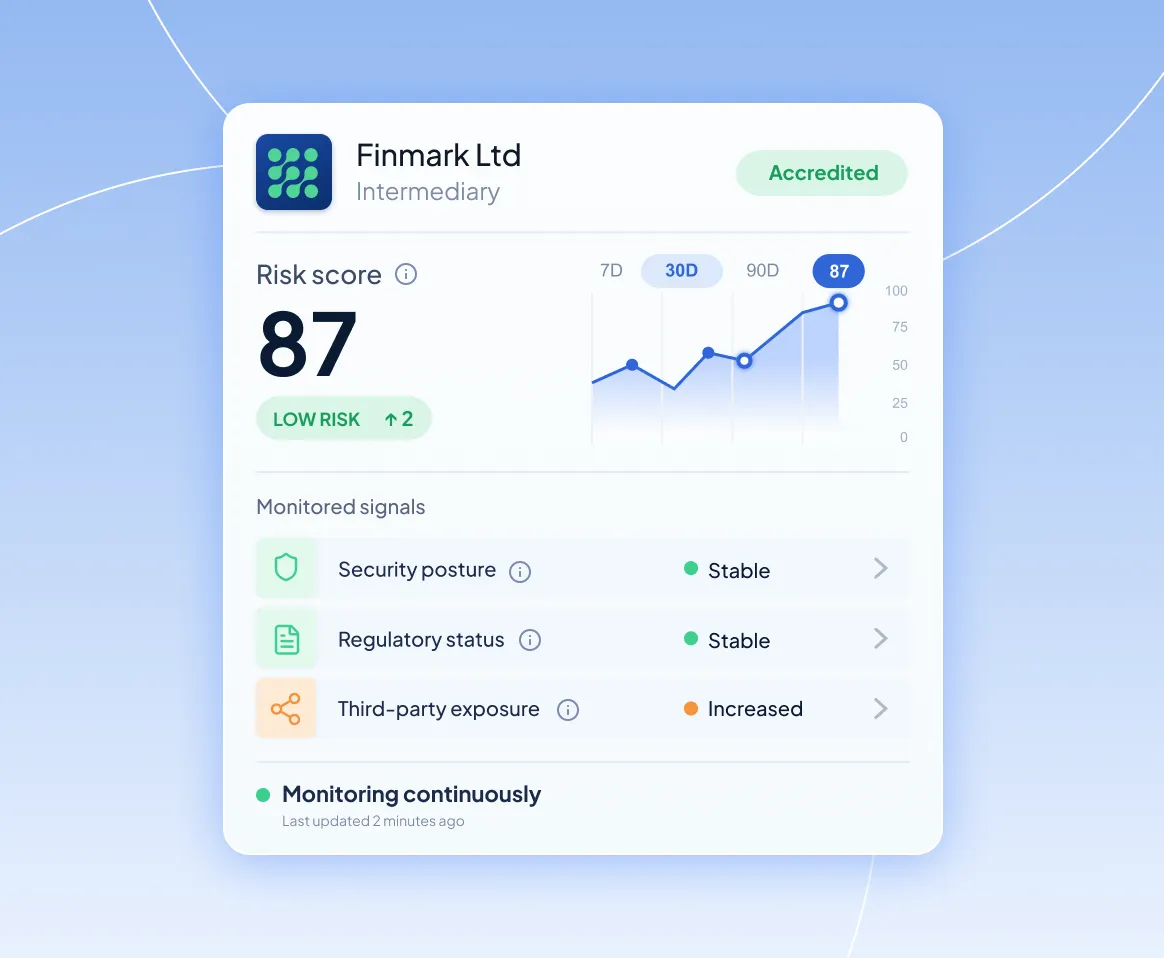
One score, monitored continuously
Every accredited intermediary and third-party provider gets a dynamic, standardized risk score, monitored continuously.
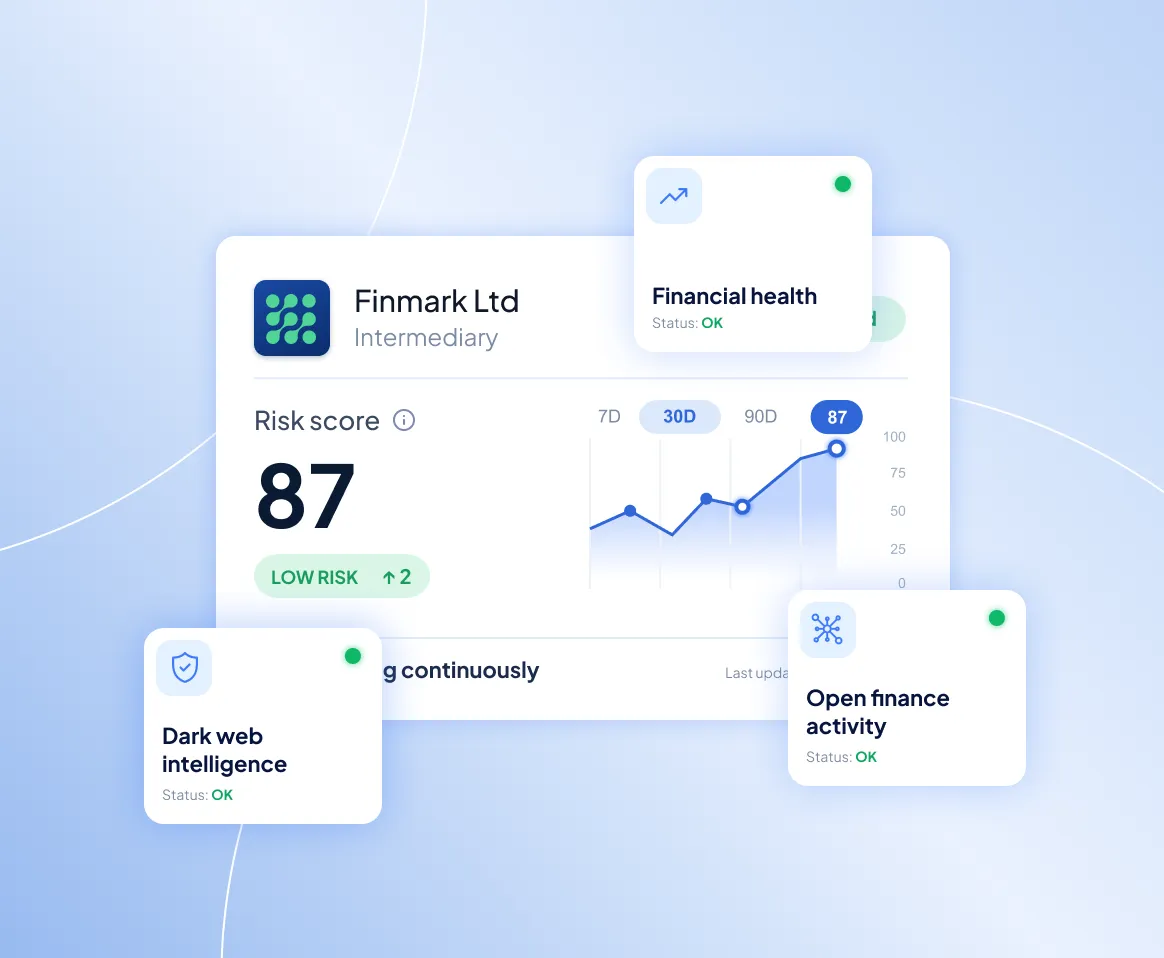
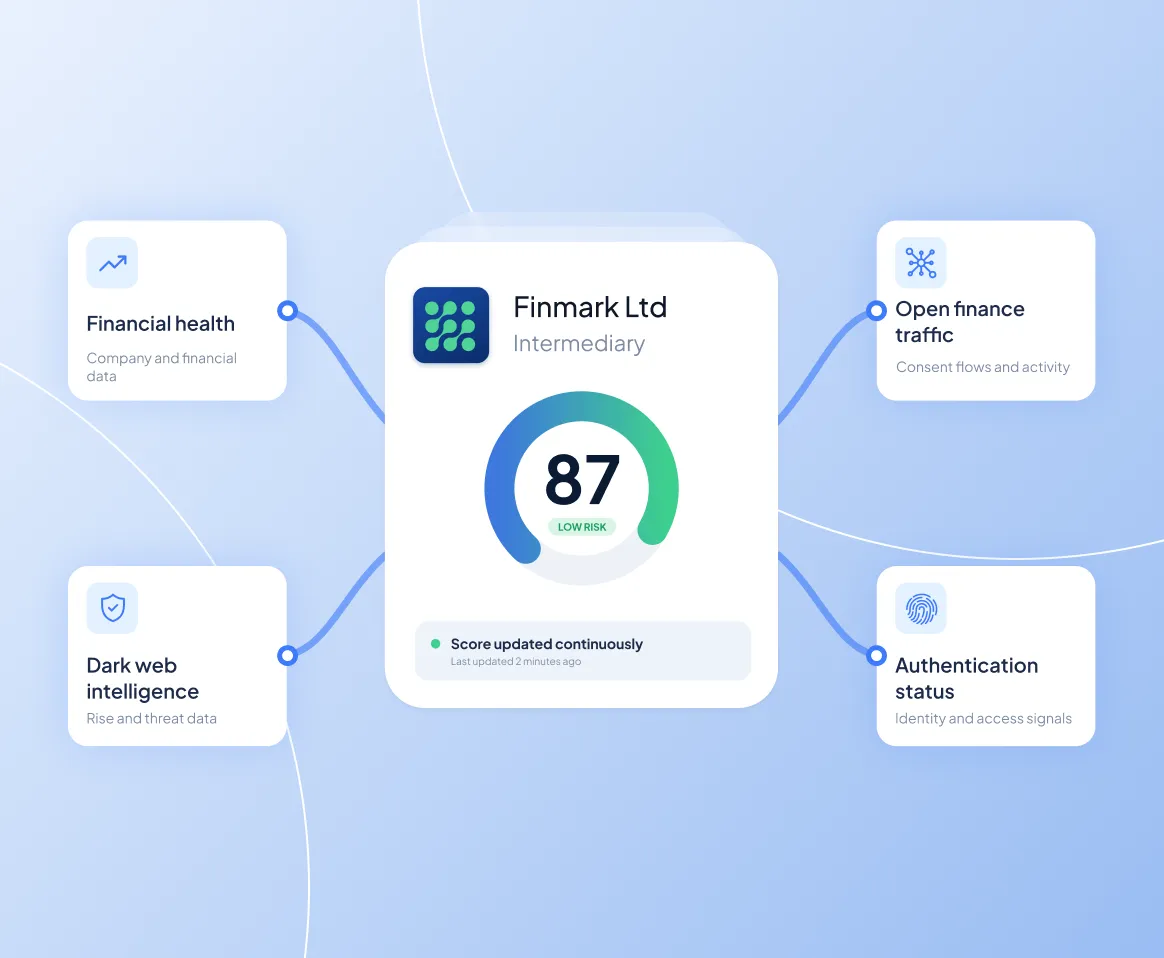
Built from real signals, not self-reporting
The score incorporates external data - financial health, dark web intelligence etc - alongside analysis of open finance traffic itself: including consent flows and authentication status.
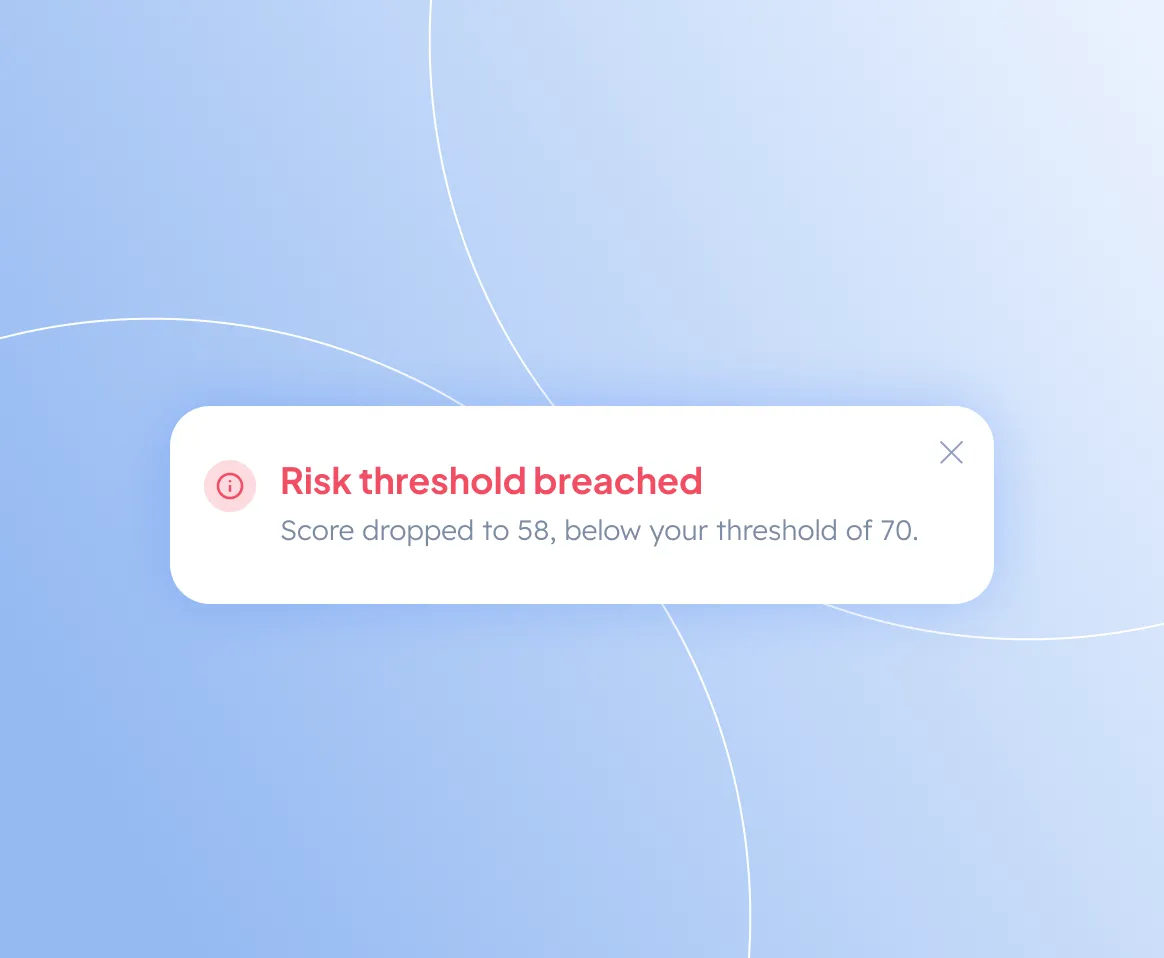
An alert before you need to ask
Financial institutions set their own risk threshold and receive a real time alert the moment a partner's score drops below it - enabling a timely, informed decision instead of a reactive scramble.
Visible to everyone it affects
Intermediaries and third-party providers see their own score and where to improve it. Additionally, intermediaries see their third-party provider ecosystem. Financial institutions get network-wide dashboards for benchmarking and strategic oversight.
Accountability without central gatekeeping
Financial institutions set thresholds and act on them independently, restricting or resuming access as they see fit. Intermediaries and third-party providers can see their own score moving, so they can act on a dip before it reaches a financial institution's threshold.
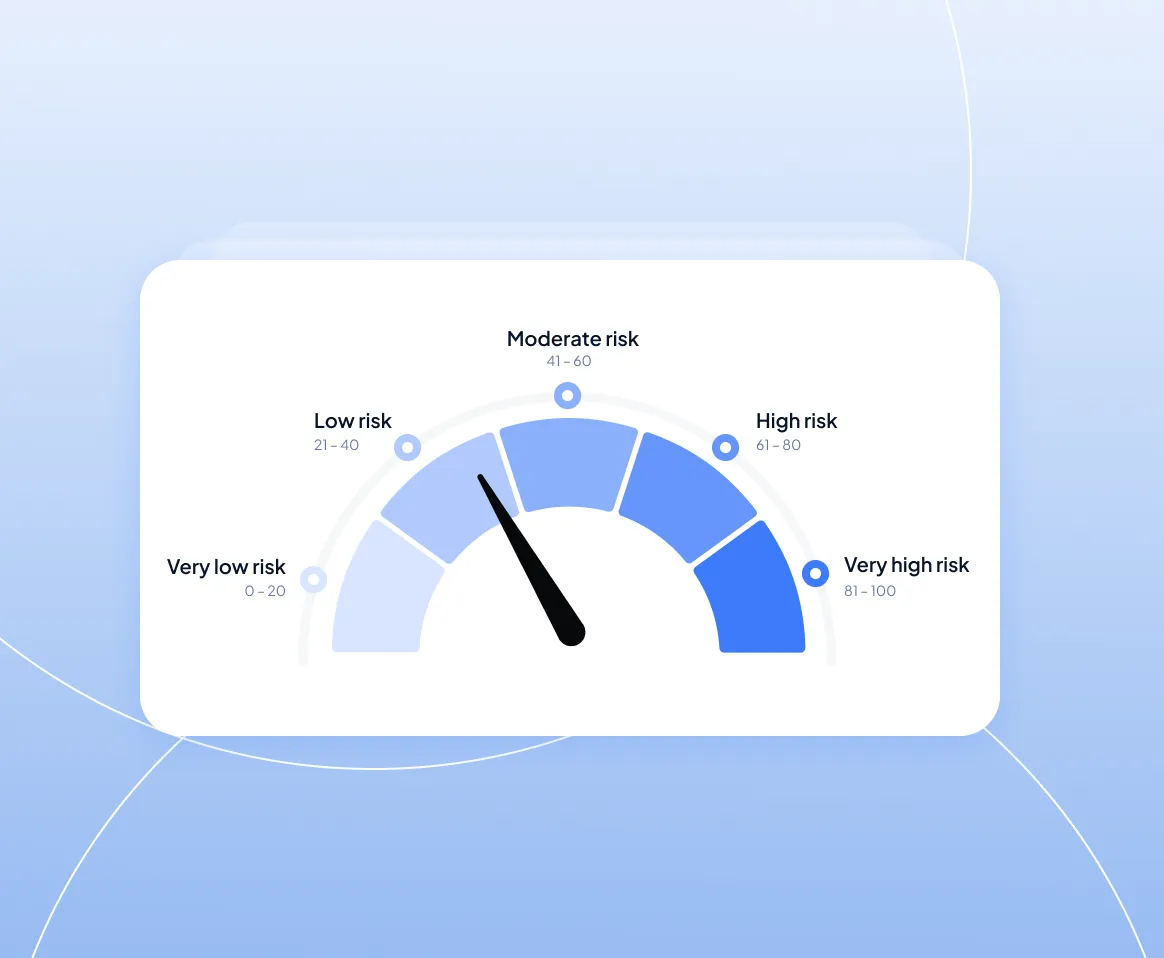
How the score is read: five risk bands
Every Risk Indicator score sits on a 0-100 scale, grouped into five bands. A score doesn't just say "low risk" or "high risk" in isolation - the band shows where a participant sits, and continuous scoring means that band position is current, not a snapshot from the last review.
Three steps to continuous oversight
The moment a participant joins the network, real time risk monitoring begins.
Accredited participants are scored
Intermediaries and third-party providers receive a risk score built on their public signals. Traffic signals and Accreditation signals refine the score and maximize accuracy.
The score updates as new signals arrive
Real time monitoring re-scores participants continuously.
Those entitled to a score decide how to act on it
Financial institutions get alerted the moment a score crosses their threshold, enabling a timely decision instead of a reactive scramble. Intermediaries and third-party providers see the same signals moving in real time, so they can act on a risk score dip before it ever reaches that threshold.

Open finance risk management insight
Latest industry news and perspectives from the Invela team.



Know where you stand, before anyone has to ask
Frequently asked questions
Scores are transparent and continuously monitored, which helps exclude bad actors and rewards participants who keep their risk low. Institutions act on thresholds themselves, with no central gatekeeper.
Alerts when a score drops below a threshold set by the institution, so a decision to restrict or resume access is timely and based on objective evidence.
It gives continuous visibility into the providers they connect on to, including risk several hops away that periodic checks miss. Intermediaries can act on a dip before a financial institution restricts account access.
They set their own risk thresholds and receive an alert when a connected participant’s score falls below them. Network-wide dashboards support benchmarking and strategic oversight, and institutions decide independently whether to restrict or restore access.
Yes. They see their own score, the factors driving it and the steps that raise it, so monitoring becomes a remediation path rather than a pass or fail gate. Intermediaries also see the scores of the third-party providers they connect.
It moves as underlying signals change, not on a review schedule. A change in a participant’s security posture or data handling can move the score close to when it happens, unlike an annual audit that is fixed until the next cycle.
Public signals such as financial health and dark web intelligence, plus analysis of open finance traffic (consent flows, authentication status and anomalies) and Accreditation signals. It does not rely on self-reporting, and it separates verified data from lower-confidence signals.
Generally Low or Very Low risk, which means 80 or above. A score in High or Very High is not a fixed verdict: the same scoring shows which factor drove it down, giving the participant a path back.
On a 0 to 100 scale, where 100 is the lowest risk, grouped into five bands: Very Low (90–100), Low (80–89), Medium (70–79), High (60–69) and Very High (0–59). The band shows where a participant sits now, not a snapshot from the last review.
A continuous risk monitoring and dynamic scoring system for accredited intermediaries and third-party providers. It gives financial institutions real-time visibility into the participants they connect to, and gives participants a live, actionable score of their own standing.
